Screen Time Is Not Only About Hours. It Is About What the Screen Replaces.
 By MyEduate
For parents and teachers.
It is 8 pm. Homework is done, or almost done. Your child is on the phone again, and you are not sure what to say.
Is one hour too much? Is two hours fine? Your neighbour's child has a tablet all day and seems okay. Your own child gets angry when you take the phone away.
Almost every parent feels this. Phones and tablets are part of school, friends and family life now. Taking them away completely is not realistic for most homes. So the real question is not "screens or no screens". It is "how much, and in place of what".
First, what do children's doctors in India say?
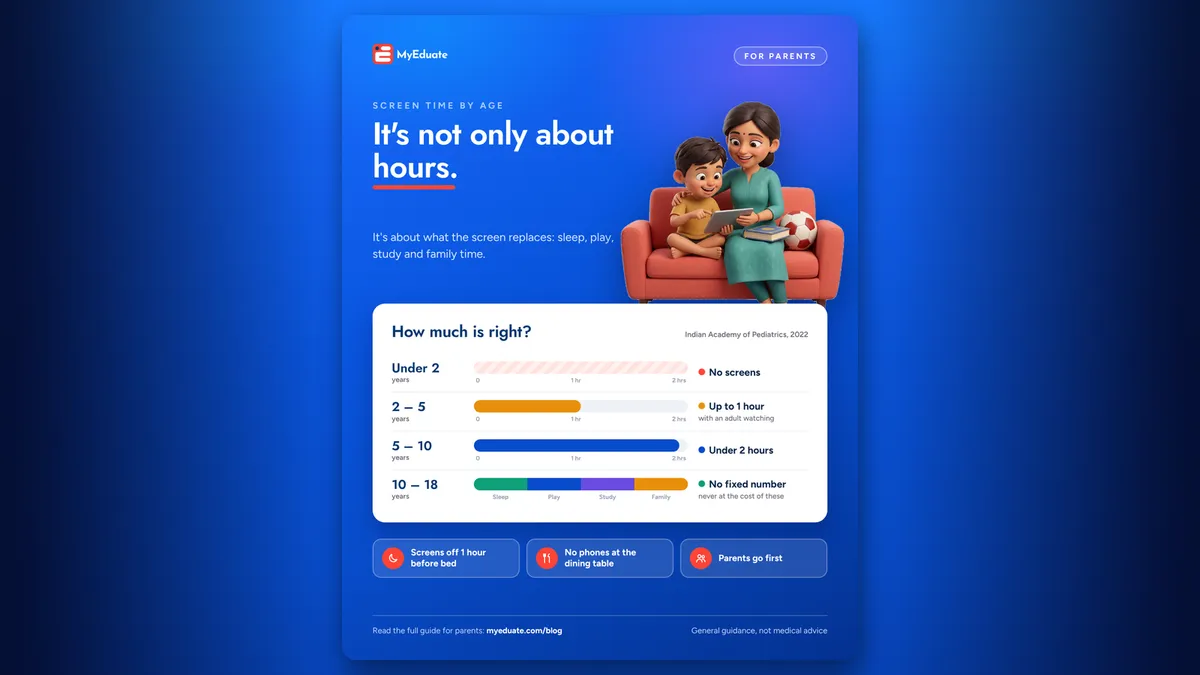
The Indian Academy of Pediatrics (IAP), the body of children's doctors in India, published guidelines on screen time in 2022. In simple words, they say:
| Age | What the IAP recommends |
|---|---|
| Under 2 years | No screens at all. |
| 2 to 5 years | At most 1 hour a day, with an adult watching along. |
| 5 to 10 years | Less than 2 hours a day. |
| 10 to 18 years | No fixed number. Screen time must not cut into sleep, outdoor play, study, meals and family time. |
These numbers are a useful guide. But the doctors also make a bigger point, and it matters more than the numbers.
The real question: what is the screen taking away?
For teenagers, the IAP does not give a number. It gives a list of things every child needs each day:
- At least 1 hour of outdoor play or physical activity
- 8 to 9 hours of sleep at night
- Time for schoolwork
- Meals without hurry
- Hobbies, friends and family time
The rule is simple. If screens start eating into any of these, screen time needs to come down.
The American Academy of Pediatrics now says much the same thing. It asks parents to think about what screens are "crowding out", instead of only counting hours.
Not all screen time is the same
One hour on a video call with grandparents is not the same as one hour of short videos, one after another. Neither is drawing on a tablet, learning to code, or watching a science show together.
A useful way to think about it:
- Better screen time: talking to family, making something, learning something, watching together and talking about it.
- Screen time to watch out for: endless scrolling, autoplay videos, and games that are hard to stop.
You do not need to ban the second kind. Just make sure it is not most of the day.
Five house rules that work better than a timer
Most of these come straight from the IAP's "digital hygiene" advice for families. They are easier to follow than counting minutes, because they are about when and where, not how long.
- Screens off one hour before bed. The light from screens makes it harder for children to fall asleep. Charge phones outside the bedroom at night.
- No phones at the dining table. Meals are often the only time the whole family sits together. Keep it that way.
- Keep some places screen-free. The IAP suggests the bedroom, dining table and kitchen. Pick the ones that work for your home.
- Parents go first. Children copy what we do, not what we say. If we put our phones down at dinner, they will too.
- Talk about it, often. Ask what they are watching and why they like it. A child who talks to you about their screen is safer than one who hides it.
When to worry, and when not to
Every child gets upset sometimes when a game is stopped. That is normal. It is worth a calm conversation, and maybe a word with your child's doctor or class teacher, if you notice these things over several weeks:
- Sleep is getting shorter or later
- Your child stops playing outside or meeting friends
- Marks are falling and homework is being skipped
- Strong anger or tears every time the device is taken away
None of these mean something is wrong with your child. They only mean the balance has tipped, and it is time to adjust it together.
A note for schools and teachers
Schools can help parents a lot here. A few small steps make a difference:
- Share simple screen-time guidance with parents at the start of the term or in a parent-teacher meeting.
- Avoid setting online homework that keeps children on screens late at night.
- Give parents one clear place to see homework and notices, so children do not need to scroll through many groups to find them.
In short
Use the IAP limits as a guide: no screens under 2, up to one hour from 2 to 5, under two hours from 5 to 10. For older children, watch what screens are replacing, not just the clock.
Protect sleep, outdoor play, meals and family time. Set a few simple house rules. And go first yourself.
Children do not need a perfect screen plan. They need parents who notice, and who talk to them about it.
This article is general guidance for parents, based on published paediatric guidelines. It is not medical advice. If you are worried about your child's health, sleep or behaviour, please speak to your paediatrician.