Never Make a Child Ask Their Parents for the Fees
 By MyEduate
A simple look at fee collection, and the one place it should never go through.
It is a Tuesday morning. The term started two weeks ago.
The class teacher has a printed list on her table. The office sent it up. She reads out three names and tells those children to remind their parents about the fees.
Two of the children forget about it in five minutes. The third one does not. She is nine years old. She already knew. Her parents talked about it at home on Sunday night. She looks at her desk for the rest of the period.
The money will come by Friday. The method works. That is why schools still use it.
No school planned this
Nobody sat in a meeting and decided that fee collection should go through a classroom. It just happened, slowly, over many years.
Think about why. The accounts clerk has a list of names. He has no easy way to contact parents. The class teacher meets those same parents every day. She is already sending notes home about books and uniforms. One more line costs nothing.
And for a long time, there was no other way. Before every parent had a mobile phone, the child was the only way to send a message home.
So this is not about schools doing something wrong. It is about an old habit that is no longer needed, and what it quietly costs you.
What it costs
The child carries a problem that is not hers
A pending fee is an adult matter. The reason is usually a late salary, a hospital bill, or a bad month in business. The child cannot change any of it. She also does not know when it will change.
But now the other children in her class know. For a nine-year-old, that is not a small thing. That is what she thinks about at lunch.
The teacher is given the wrong job
Ask any class teacher what she dislikes most about the term. Fee follow-up will be near the top.
Parents trust her more than anyone else in the school. And you are asking her to use that trust to collect money the office could not collect.
Most teachers do it gently. But something changes. A parent who owes money starts avoiding the teacher at the gate. He skips the parent meeting. He stops replying in the class group. The study-related conversation — the one that would have actually helped the child — stops, because of a pending amount that has nothing to do with it.
And it does not collect very well either
This is the part most schools do not notice.
When teachers do the follow-up, it is slow and uneven. One teacher reminds every week. Another forgets for a month. A third stops asking, because she can see the family is struggling and she does not want to hurt them.
Nobody in the office can see which of these is happening. The office only sees that the amount is still pending. So it assumes the parent does not want to pay. Very often, the parent was simply never asked properly.
The simple rule
Money is between the school and the person who pays. It should not go through the classroom. It should not go through the child. Everything below is just how to do that.
What to do instead
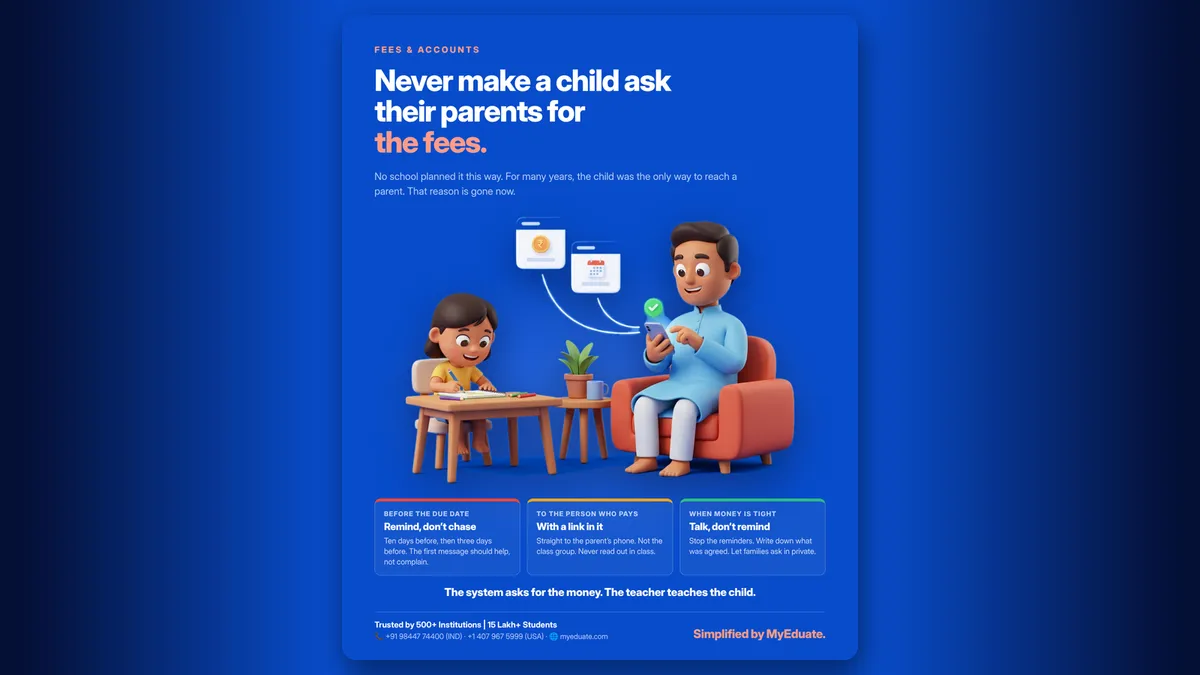
Remind before the date, not after it
Most schools start calling only after the fee is late. So the first message a parent gets is already a complaint.
Do it the other way round. Send a message ten days before the due date. Send another three days before. Only after that, send a reminder for the late amount.
Now the first two messages are helpful, not angry. And many parents are not defaulters at all. They are simply busy people who forgot. They need a reminder, not a collection process.
Send it to the person who pays
The message should go straight to the parent. On his phone. With the amount, the due date, and a payment link inside it.
Not in the class WhatsApp group. Not through the child. Not read out in class.
The payment link matters more than it sounds. Many parents want to pay but do not get around to it. The bank visit needs a free morning. The cheque needs a signature. Nobody can find the account number. A link finishes the job in under a minute. That is the difference between a parent paying on Tuesday night and a parent paying in March.
Give the follow-up to one person in the office
If the reminder does not work, the phone call should come from a named person in the accounts office. Not from the class teacher. Not from the principal, unless it has reached that stage.
One person doing the follow-up gives you something you do not have today: a record. Who was called. On which date. What they said. What was agreed.
That record also protects the family. A parent who explained his situation in October should not be asked the same question again in November.
Families who really cannot pay
Every school has them. This is where the system must stop and a human being must start.
Sending more and more reminders to a family in real trouble is not collection. They have already told you they cannot pay right now. If you keep pushing, the usual result is that they move the child to another school quietly. Then you lose the full year’s fee instead of one pending instalment.
Four things make this easy to handle:
- Write the concession rule before the season starts. Who can approve a reduction. Up to how much. Against what proof. For how long. If it is not written down, every family gets a different answer, and you cannot explain it to your trustees later.
- Give these parents a private way to ask. A parent should know whom to meet. He should not have to explain his money problem at the counter while other parents listen.
- Record the agreement, not just the balance. If the family agreed to pay in three parts, the system should know that. Otherwise reminders keep going out and the agreement means nothing.
- Stop the automatic reminders for that student. This is the most important setting in any fee software. It is also the one most often missing.
Where automatic reminders go wrong
We make this software, so we will be honest. Automatic messages can also cause damage if you switch them on without thinking.
- Sending a reminder to someone who already paid. This is the fastest way to lose a parent’s trust. If receipts are entered in the system one day late, the reminder goes out on old data. The parent who paid on Monday gets a message on Tuesday.
- Too many messages. Three reminders at the right time are helpful. Nine is harassment. Parents will mute your number — and then they also stop seeing your attendance alerts and circulars.
- Wrong language and wrong tone. A message that sounds like a bank notice reads badly from a school. It should sound like your school. In most of Karnataka that means Kannada as well as English.
- Showing the amount where others can see it. A pending amount against a student’s name is private information. Putting it in a class group, or on a notice board, means you have shown it to other people. The new data protection law takes this seriously. Parents never forget it.
What the correspondent should see on the 5th
Without calling anyone, you should be able to see:
- How much has been collected this month, against how much was due.
- How that compares with the same date last year.
- Which classes or branches are behind. And whether that is a few big amounts or many small ones, because the two need different action.
- How many families are on an agreed instalment plan, and whether they are paying on time.
- How many reminders went out, and how many actually brought money in.
Nobody should have to walk to the accounts room for this. And no teacher should have to read out a name.
In short
Your school needs the fees. Nobody is arguing with that. Salaries depend on it. A school that collects badly cannot teach well for long.
But collection works better when it is done by the office, on a fixed schedule, directly with the parent. And it hurts much less.
The system asks for the money. The teacher teaches the child. No nine-year-old carries a message she did not choose and cannot do anything about.
If you change only one thing after reading this, change that.