
Most Students Revise From Chapter One. There Is a Better Way.
 By MyEduate
For students, parents, teachers and school management.
Two weeks before the mid-term, a student sits down to revise. She opens the textbook at Chapter 1 and starts reading. She is a serious student, so she works through it carefully. By the time the exam arrives she has covered Chapters 1 to 7 thoroughly and skimmed the rest.
The exam asks about Chapter 9. She knew Chapter 1 perfectly well before she started.
This is the single most common way students lose marks they could have kept. Not laziness, not lack of preparation — just revising in the order the book is printed rather than in the order they need it. And it happens because, when revision begins, nobody in the room actually knows which chapters are weak. The student is guessing. So is the parent.
There is already an answer to that question. It is just written in the wrong place.
The record nobody keeps
Most teachers give a short test at the end of a chapter — ten marks, fifteen minutes, no announcement, no hall ticket. A slip test. They have been doing it for decades, usually without being asked.
Those tests are the best early signal a school has. They are taken while the chapter is fresh, they are honest because nothing much rides on them, and they tell you exactly where a student stands on exactly one piece of the syllabus.
And then the marks go into a teacher’s personal register and are never read again. When she is on leave, nobody can see them. When she changes schools, they leave with her. The student certainly never sees the pattern. By the time the mid-term result arrives — one number for the whole subject — the information that would have made revision efficient has been sitting unused for three months.
MyEduate’s new Slip Test feature does one simple thing: it records those marks against the chapter they belong to, so they are still there when revision starts.
What a student can actually do with it
This is the part worth reading slowly, because the marks are only useful if you know what to do with them.
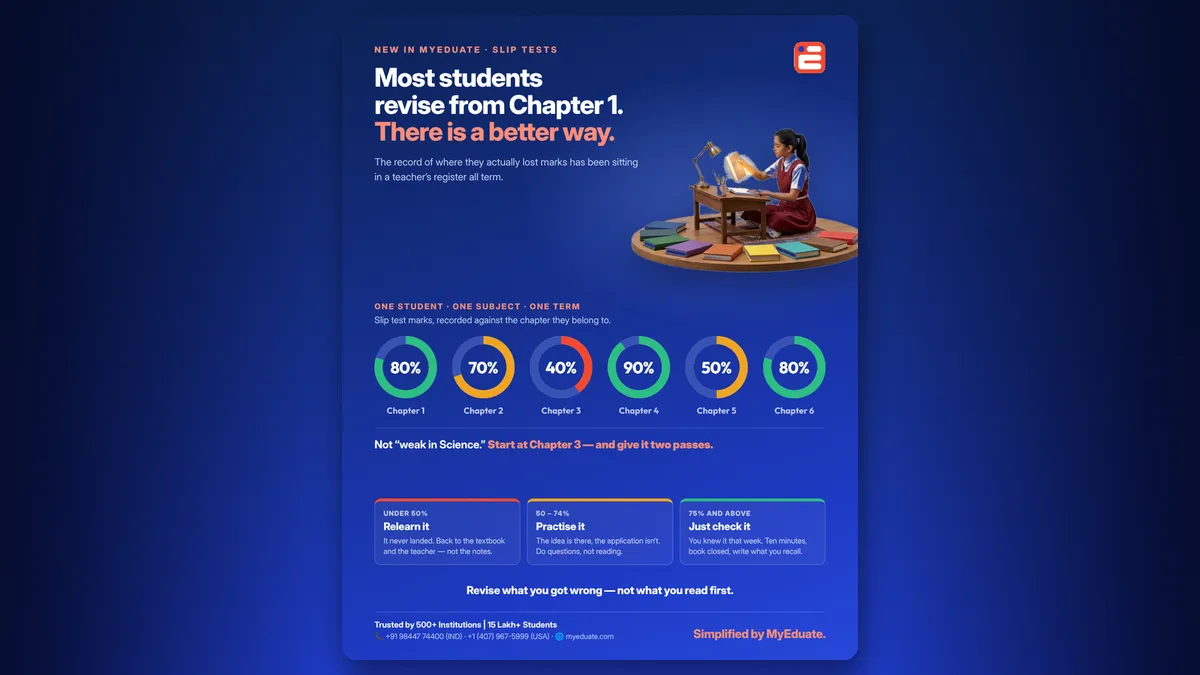
A term’s slip test scores for one subject might look like this:
- Chapter 1 — 8 / 10
- Chapter 2 — 7 / 10
- Chapter 3 — 4 / 10
- Chapter 4 — 9 / 10
- Chapter 5 — 5 / 10
- Chapter 6 — 8 / 10
That is not a report card. It is a map. And it changes the first decision a student makes, which is where to begin.
Sort by score, not by chapter number
Revision should start with Chapter 3, not Chapter 1. This feels wrong — the instinct is always to begin at the beginning — but the beginning is where the student is already strongest, and the chapters at the end of the list are the ones that get skimmed when time runs out.
Treat the three bands differently
Under 5 / 10 — relearn it. This is not revision. The chapter did not land the first time, and reading the notes again will not fix it. Go back to the textbook, work the examples from the start, and ask the teacher about the part that breaks. Budget real time for these — they are the only chapters that deserve a full session.
5 to 7 / 10 — practise it. The idea is mostly there and the application is not. Do questions, not reading. Past papers, exercise sums, the questions at the end of the chapter. Mark your own answers honestly.
8 / 10 and above — check it, do not re-read it. A strong score means you knew it that week. It does not mean you know it today, and three months is long enough for anything to fade. Spend ten minutes covering the page and writing down what you remember. If it comes back, move on. Re-reading a chapter you already know is the most comfortable and least useful thing a student can do with an evening.
Give the weak chapters two passes, not one long one
If Chapter 3 needs three hours, it is far better spent as ninety minutes now and ninety minutes five days later than as one three-hour sitting. Material revisited after a gap sticks considerably better than the same time spent in one block — this is one of the most consistently supported findings in how memory works, and almost nobody uses it, because cramming feels more productive while you are doing it.
Practically: this is why the plan has to start with the weak chapters. You need room for the second pass. Leave them to the last week and there is only time for one.
Re-test instead of re-reading
The fastest way to find out whether a chapter has come back is to be tested on it again. Close the book and write down everything you can remember before you open the notes. It is uncomfortable, and that discomfort is the point — pulling an answer out of memory is what strengthens it. Looking at the page again mostly produces the feeling of knowing without the knowledge.
Which is also a reason for students to keep their slip test papers. The questions a teacher thought were worth asking at the end of a chapter are usually a good guide to what the examiner will ask about it.
Look for the pattern, not just the scores
Sometimes the weak chapters cluster. If the low marks are all from the same fortnight, the problem may not be the chapters at all — it may be the week the student was ill, or the stretch just before a festival break when nobody was concentrating. That is a different problem with a different fix, and it is only visible when the scores sit side by side.
The same is true across subjects. If a student is dropping marks on the chapters that lean most on one skill — word problems, say, or diagram-based questions — that is one thing to fix rather than six.
Building the actual plan
A workable method, two or three weeks before the exam.
- List every chapter with its slip test score. All subjects on one page. This page is the plan.
- Mark each one relearn, practise or check. Use the three bands above. Be honest about the middle band — it is the one students most often promote to “check” because practising is harder.
- Count the relearn chapters first. If there are nine of them and eight days, that is worth knowing now rather than discovering it on the last weekend. It is also the moment to ask a teacher for help, while asking is still useful.
- Schedule relearn chapters in the first half, twice each. First pass early, second pass a few days later. Protect the gap.
- Put the practise chapters in the middle, as questions only. No reading sessions for these.
- Leave the strong chapters to the last two or three days. Ten-minute retrieval checks, not full revisions. They also make good confidence work the night before.
The one thing to get right
The plan is built from what the student actually got wrong, not from what they feel least confident about. Confidence is a poor guide — students often feel least sure about the chapter they revised most recently and most sure about the one they have forgotten entirely.
For parents
The most useful thing this changes at home is the question you get to ask.
“Why are your marks low?” has never worked, because the child does not know either. “You found Chapter 6 hard — shall we go through it this weekend?” is a question a child can answer, and it puts you on the same side of the problem.
You also find out in time to do something. A chapter that went badly in July is a problem that can be fixed in August. The same problem discovered on the mid-term report is one your child carries into the final.
Two cautions, in your child’s interest. A slip test is a fifteen-minute exercise, not a verdict — if every one of them produces a conversation at home, you will teach a child to dread something that was designed to be low-stakes. And resist comparing scores with other children: on a ten-mark chapter test, the comparison teaches nothing and costs a great deal.
For teachers
The same map works for a whole class, and it points at your teaching rather than at individual children. If two-thirds of a section lost marks on the same chapter, that is not twenty weak students; that is one chapter that needs revisiting before the exam — and now you have the evidence to say so in a staff meeting rather than a feeling.
It also means the class revision before the mid-term can be aimed. Instead of covering the whole term at equal pace, spend the time on the three chapters the data says the class did not get. And you stop carrying the record: enter the marks once and the class teacher, the coordinator and the parent can all see them without a single phone call to you.
For correspondents, principals and management
You gain a continuous view of learning rather than three examination snapshots a year. Which chapters trouble every section, suggesting the material or the pacing rather than the teacher? Which sections are drifting apart? Where should the extra class before the exam actually be spent?
There is also a quieter benefit. A school that can show a parent exactly what was assessed, when, and how their child did is in a much stronger position in a difficult conversation than one offering a single number and a recollection.
A caution worth taking seriously
Making every small test visible can go wrong, and we would rather say so now than watch it happen.
If each chapter test is treated as a result, children start dreading them. And if teachers know that every mark will produce a phone call, they will quietly inflate the scores or stop setting honest tests — at which point the school has destroyed the very signal it was trying to capture. A slip test is only useful while it stays low-stakes.
- Treat the marks as information for planning, never as a ranking.
- Do not send a notification for each test. A chapter-wise view is enough, and far less anxious.
- Keep class rank and class average off a ten-mark chapter test.
- Tell parents before switching it on that these are practice marks, and what they are not.
- Let a teacher leave a test unpublished when it was genuinely diagnostic. A teacher who cannot risk a hard question will stop asking hard questions.
How a school can start
- Pick one class and one subject. One enthusiastic teacher will teach you more than a circular to all staff.
- Agree what a slip test is. Ten marks, fifteen minutes, end of chapter. If every teacher interprets it differently the records will not compare.
- Tell parents first. One short note. This single step prevents most of the problems above.
- Run a full chapter cycle before judging it. The value appears when there are four or five chapters to compare, not after the first test.
- Teach the students to read it. Spend twenty minutes of one class showing a section how to turn their own chapter scores into a revision plan. That lesson is worth more than the feature.
The short version
Every student revising for a mid-term is answering one question: where do I start? Most of them answer it with the table of contents, because that is the only guide they have.
The better guide already exists. It has been sitting in teachers’ registers, in handwriting, for as long as there have been schools. All we have done is keep it, and put it in front of the student while there is still time to use it.